
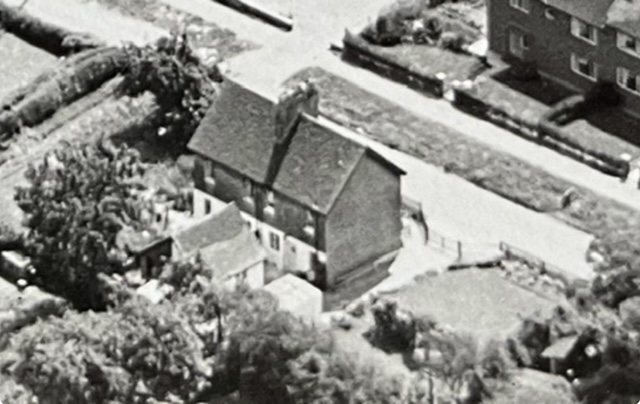
On Park Lane in Broxbourne, Hertfordshire, stood a modest worker’s cottage that became, for much of the early 20th century, a centre of care for the community. Known locally as The Queen’s Nurses’ Cottage or sometimes The Parish Nurses’ Cottage, this small house was more than just a dwelling. It represented the professional presence of the district nurse — a vital figure in village life at a time when medical care was often scarce, transport limited, and families relied heavily on home-based nursing.
Origins of the Nurses’ Cottage
The cottage was semi-detached, built between 1871 and 1881 by the Smith-Bosanquet family, then owners of the Broxbournebury estate. Like many landed families of the period, they constructed workers’ cottages to provide accommodation for estate employees. Census records from the 1880s show the first tenants as a local carpenter and his family.
The use of the house changed in the early 20th century. On 13 December 1904, Horace James Smith-Bosanquet endowed funds in memory of his late wife, Cecilia Jane, to establish a nurse for the sick poor of the parish. As part of this arrangement, one of the Park Lane cottages was made available for the district nurse. It sat conveniently next door to the village police house — a pattern repeated in other parts of the country, reflecting how local services such as policing, nursing, and education were gradually being professionalised and embedded in village life.
By 1911, the census recorded District Nurse Catherine Smith living in the cottage. She worked in Broxbourne for well over a decade, employed by the Broxbourne Nursing Committee, which in turn was affiliated to the Hertfordshire District Nurses’ Association and, ultimately, to the Queen’s Institute of District Nursing (QIDN). This affiliation tied the small parish scheme into the larger national system of community nursing, though local variation remained strong. Each nursing association set its own terms of employment, provided accommodation, and often supplied transport — bicycles initially, and later cars — as the nurses’ work demanded travel over ever-wider areas.
District Nursing Between the Wars
The period between the First and Second World Wars was one of great change for district nursing. The movement had begun in the late 19th century, rooted in philanthropy and local subscription. By the 1930s, however, district nursing was increasingly seen as a universal service, part of the patchwork of provision that would eventually lead to the National Health Service. Local committees, such as Broxbourne’s, struggled with shortages of staff and the challenges of covering multiple parishes, but they also played a crucial role in ensuring that families could access trained nursing at home.
A cottage like the one on Park Lane was therefore more than just a home. It was a visible symbol of the nurse’s presence — a place where parishioners knew help could be found, and where the nurse herself lived among the people she served. Nurses moved on as their careers developed, sometimes marrying, sometimes emigrating, sometimes transferring to other posts, but the cottage provided continuity for the community.
The Arrival of Nurse Annie Buckle
In 1932, following the departure of a previous nurse, the Broxbourne Nursing Association appointed Nurse Annie Buckle. Her appointment was formally recorded in the committee minutes of 12 July 1932: she was to receive a salary of £130 per year, with accommodation provided free of charge in the Park Lane cottage, along with the use of a bicycle for her rounds.
By this point, Annie was an experienced nurse and midwife with a remarkable backstory.
Born in Willesden, London, in 1894, Annie grew up in a family where some of her sisters later entered domestic service. In 1917, at the age of 23, and with two of her sisters, she joined the Women’s Auxiliary Army Corp (WAAC) which later became the QMACC. Like many women of her generation, she served behind the Western Front in France, working in conditions of immense strain. Discharged in 1919 as medically unfit, it is presumed that she remained in France until September 1921 (when the unit was eventually disbanded) to help with the clean-up operation which included tending to the graves of the fallen. Her service was recognised with war medals – with the stipulation that her family must be notified if no word was received from her.
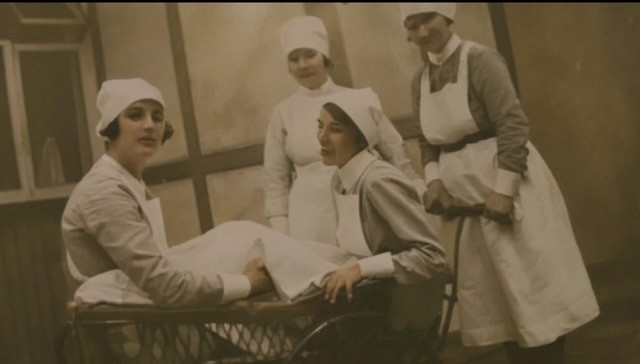
Returning to Britain, it is believed that Annie pursued nursing in earnest and that she trained at the Watford Peace Hospital, which was established in 1925 as both a memorial to the fallen and a centre for the rehabilitation of the injured. It followed the curriculum of the Queen’s Nursing Institute, and Annie’s training there equipped her both as a health worker and as a midwife. In November 1928 she passed the Central Midwives Board examination, joining the official Midwives’ Roll in 1929. It is not believed she took the Queen’s Nurse examination, but this was not unusual for many nurses working in the community at the time.
Her first post was in Pirton, near Hitchin, where she worked as a district nurse and midwife until 1932. When the Broxbourne committee sought a new district nurse that year, Annie was appointed.
A Beloved Nurse
For four years, Nurse Buckle lived in the cottage on Park Lane and cared for the people of Broxbourne.
Her work was not easy. District nurses of the time often faced long hours, travelling in all weathers to attend patients at home, delivering babies, dressing wounds, and offering comfort to families. The short 1935 film Queen’s Nurses at Work in Country Districts gives a glimpse of what that work was like.
Nurses’ bicycles were both a lifeline and a hazard, as the roads of the 1930s were increasingly busy with cars.
Tragic Death
On 22 October 1936, while cycling along Hoddesdon High Street to a patient visit, Annie was struck by a car. She was taken to Hertford County Hospital but died shortly after admission. She was 42. She was remembered by those who knew her as a dedicated and compassionate figure.
Newspaper reports from the time of her death emphasise the affection in which she was held: Dr Carpenter described her as “a skilful, loving and devoted helper of the sick and afflicted,” while parish minutes from 1937 noted with shock and sorrow her sudden loss. Everywhere in Broxbourne Nurse Buckle was mourned, but nowhere more than in the school, where the children loved her. Knowing this, one of the parents and the church verger lined her grave with white and mauve chrysanthemums.
Her funeral on 27 October 1936 drew some 250 mourners to St Augustine’s Church, Broxbourne. Among them were mothers, family members, fellow nurses, members of the Midwives’ Institute, and representatives of the Hertfordshire County Nursing Association. She was buried in the churchyard, where her grave now lies next to the WW2 Commonwealth Grave of Colonel Edward Hooper and his wife Veda Mary.
Legacy
The Queen’s Nurses’ Cottage continued in use until the mid-20th century. In July 1946, the property was sold along with parts of the Broxbournebury estate at auction. It is unclear from records who bought the cottage, but it was let to the Broxbourne and District Nursing Association; however, in 1948 Hertfordshire County Council purchased it to stop the possible eviction of a nurse. By the 1960s, district nurses were increasingly housed elsewhere, and the old model of a dedicated ‘nurses’ cottage’ fell away.
Yet the legacy endures. Today, the Hertfordshire Community Nurses Charity is the successor of the county’s district nursing associations. The story of Park Lane Cottage and of Nurse Annie Buckle is part of that wider history — one of service, community, and the often-overlooked contribution of women whose work sustained families through war, poverty, and change.
Nurse Buckle’s life was short but extraordinary: a woman who served her country in war, is presumed to have trained at the distinguished Watford Memorial Hospital, and devoted herself to the care of mothers, babies, and the sick poor. Her presence in Broxbourne left a deep impression, and her grave still speaks of a community’s grief. Restoring her story to local memory ensures that she is remembered not only as a casualty of a road accident but as a symbol of the resilience, compassion, and professionalism of district nurses in the first half of the 20th century.
Acknowledgements
Thank you to Eve Buckle for permission to use the photograph of Nurse Buckle and tell her story.
Thank you to B Kelly for help with the research.
Thank you to David Dent for permission to use the photograph of the Queen’s Nurses’ Cottage, Broxbourne from his private collection.


Recent Comments